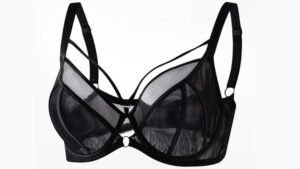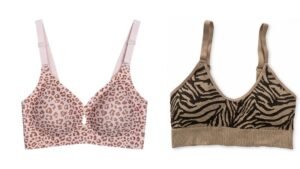
Invisible wireless bras have become an important part of the modern lingerie market. Brands increasingly want bras with cleaner surfaces, fewer visible seams and a soft, second-skin appearance under clothing. Bonding technology plays an important role in creating this type of product. However, a bonded bra is not simply made by replacing sewing with adhesive.
In our production, bonded bras are mainly built using double-layer panel bonding. The outer fabric and lining are first bonded together to create an integrated double-layer structure, which is then die-cut into the required bra panels for final assembly. Even within this construction, the production method can vary. One important difference is how the adhesive is applied between the outer fabric and lining. Some bras use continuous adhesive coating, while others use dot adhesive application. These differences can affect the hand feel, breathability, structure and production cost of the finished bra.
This article explains how double-layer bonded bras are manufactured, how continuous coating differs from dot bonding, and why bonded bras may still use sewing or bartack reinforcement in selected areas.
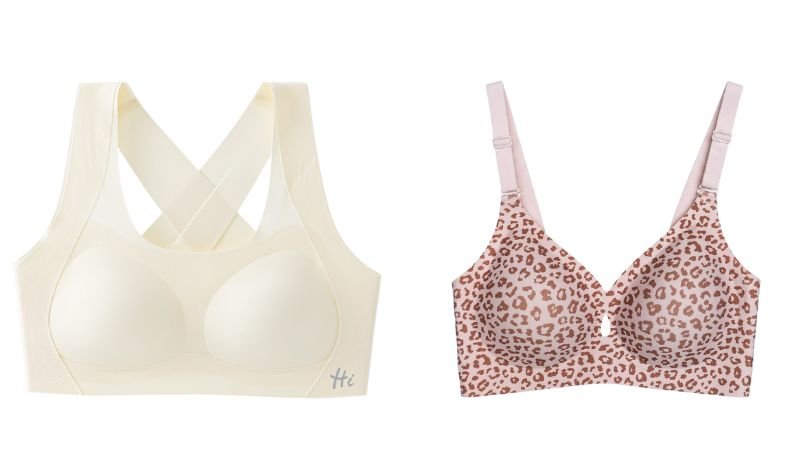
What Is Double-Layer Panel Bonding?
Double-layer panel bonding is commonly used in bonded bras where the manufacturer needs greater control over the main garment body. Here, bonding is not used only to connect two different garment panels. Instead, the factory uses adhesive to combine the outer fabric and lining into an integrated double-layer structure.
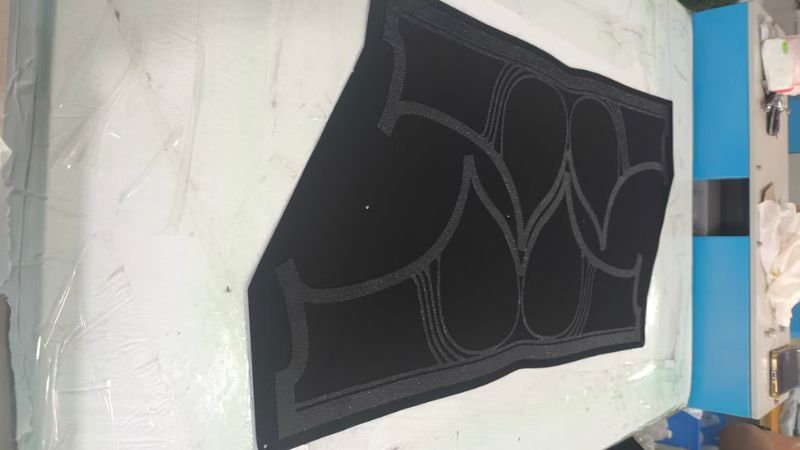
The process starts with a larger piece of fabric. Adhesive is applied to the fabric through continuous coating or dot application, and a second fabric layer is then laminated onto it. After the bonded material is cured in an oven, the final bra panels are die-cut from the double-layer material.
This means bonding becomes part of the structure of the bra panel itself, rather than simply being used at the seams. This gives the product developer more control over the body of the bra. The outer material may be selected primarily for appearance, surface feel and stretch, while the lining can contribute different properties to the finished panel. Once bonded, the two layers work together rather than behaving like two loose fabric layers.
This construction is particularly useful in smooth wireless bras where the brand wants a clean external appearance but requires a more substantial body than a simple single-layer construction would provide. The completed double-layer panels can then be assembled in different ways. Some seams may be heat bonded. Others may be sewn.
Continuous Adhesive Coating vs Dot Adhesive Application
Within double-layer panel bonding, there is another important production decision: how the adhesive is applied between the outer fabric and lining.
In our production, we commonly work with two approaches.
The first is continuous adhesive coating, which we often refer to internally as brush-glue bonding. A glue coating machine applies adhesive across a relatively large and continuous area of the fabric before it is laminated with the second fabric layer. After bonding and curing, the double-layer material is die-cut into the required bra panels.
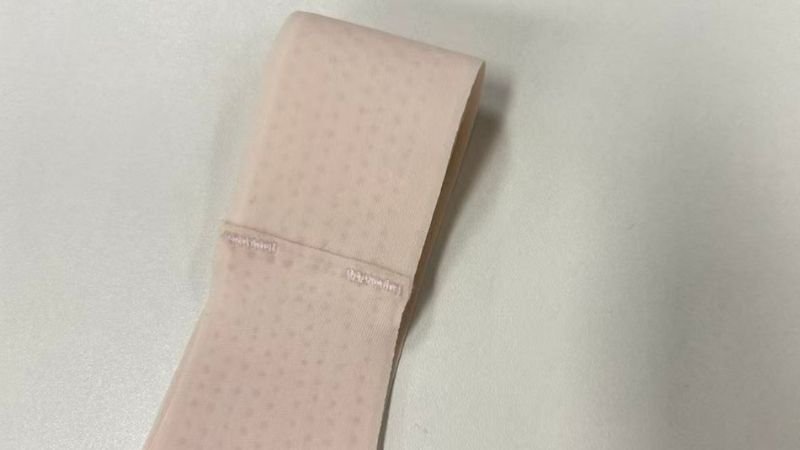
The second method is dot adhesive application. Instead of coating the surface continuously, a dot glue machine applies adhesive in separated points across the fabric before the second layer is laminated. After bonding and curing, the material is also die-cut into the required bra panels. A single adhesive-dotted bra may feature over a thousand dots.
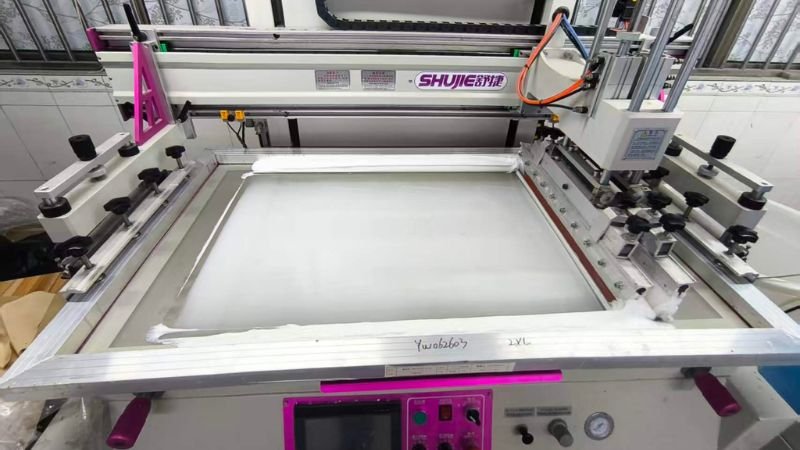
Both methods create a double-layer bonded component, but they do not create exactly the same product.
| Comparison | Continuous Adhesive Coating | Dot Adhesive Application |
|---|---|---|
| Adhesive distribution | More continuous coverage | Adhesive distributed in separated dots |
| Machine used | Glue brushing / coating machine | Dot glue machine |
| Layer integration | More uniformly bonded across the panel | More discontinuous connection between layers |
| Breathability | Generally lower when other conditions are similar | Generally better because more fabric area remains uncovered |
| Adhesive consumption | Usually higher | Usually lower |
| Production cost in our experience | Generally higher | Generally more cost-efficient |
| Hand feel | More integrated and substantial | Usually lighter and softer |
| Typical positioning | Often selected for products requiring a fuller, more premium bonded structure | Often selected for comfort-focused products where lightness and breathability matter |
The difference in breathability is easy to understand. With dot application, adhesive only occupies selected points between the fabrics. More of the textile surface remains open, which usually allows better air permeability than a more continuously coated structure, assuming the other materials are comparable.
Dot bonding also normally uses less adhesive. In our production, this generally makes it a more cost-efficient option. It also tends to create a lighter structure, which can work well for everyday wireless bras where comfort and breathability are important.
Continuous adhesive coating is positioned differently. Because a larger proportion of the two fabric layers is bonded together, the panel generally feels more integrated and substantial. In our experience, this method is more often selected for higher-end bonded bras where the brand wants a fuller, more uniform double-layer structure and a more premium hand feel.
However, this does not mean continuous coating is automatically “better.” A more expensive construction only adds value when the product actually needs what that construction provides.
If the brand is developing a lightweight everyday wireless bra, increasing adhesive coverage may add cost and weight without improving the customer experience. Likewise, if the design requires a more integrated double-layer panel, choosing dot bonding only because it is cheaper may change the hand feel and structure too much.
For this reason, we normally evaluate the product as a whole: the outer fabric, the lining, stretch and recovery, required hand feel, support level, and target positioning. The adhesive application method should support those requirements rather than being selected in isolation.
For brands, this is a useful distinction because two suppliers may both quote a “double-layer bonded bra,” while using different adhesive application methods. Without understanding the internal construction, comparing those two quotations only by unit price can be misleading.
A Bonded Bra Does Not Mean Completely Stitch-Free
Another common misunderstanding is that a truly bonded bra should contain no visible sewing at all. That is not how good lingerie construction works. Bonding is valuable where it creates a better product: flatter seams, cleaner edges, reduced bulk or a more integrated structure. But a bra also contains areas that experience repeated mechanical load.
Shoulder strap attachment points are a good example. Even if the bra body and wings use bonded construction, the strap connection is repeatedly pulled during dressing and wear. Depending on the design and size range, bonding alone may not provide the most appropriate reinforcement.
For this reason, some bonded bras are bonded first and then reinforced with a bartack at the strap attachment. The bonded construction preserves the clean look of the product, while the bartack adds mechanical strength where it is genuinely needed. Other bras use conventional sewing directly in selected high-load areas. Some brands also specifically request that certain seams remain conventionally sewn, even though the main body of the garment uses bonded construction.
This is not inconsistent with the product being a bonded bra. It is simply good product engineering. From a manufacturing perspective: the best bonded bra is not the one with the fewest stitches. It is the one that uses bonding and sewing in the right places. Removing a stitch only makes sense if another construction can perform the same function reliably.
If a supplier removes sewing from a high-load area simply so the product can be marketed as “fully bonded,” that does not automatically make the garment more advanced. The real questions are whether the connection remains secure during repeated stretch, whether the garment maintains its fit, whether the construction is suitable for the intended size range, and whether the finished product still delivers the clean appearance the brand wants.
This becomes even more important as bras move into larger sizes or higher support requirements. A construction that works well in a lightweight small-size bra may need additional reinforcement when the load increases. That does not mean the bonded technology has failed. It means the construction has been adapted to the product.
When we review a bonded reference sample, we therefore do not judge its quality by counting how many stitches are visible. We look at where bonding is used, where sewing is retained and what function each connection method is performing. That tells us much more about whether the product has been engineered properly.
Which Adhesive Application Method Should a Brand Choose?
Once the double-layer bonded construction has been confirmed, the next decision is how the adhesive should be applied between the outer fabric and lining.
If the priorities are a lighter hand feel, better breathability and cost efficiency, dot adhesive application may be a better starting point. If the brand wants a more fully integrated double-layer structure and a more substantial premium feel, continuous adhesive coating may be more suitable.
However, the adhesive application method should not be selected based on cost alone. The outer fabric, lining, stretch and recovery, required hand feel, support level and target product positioning all need to be considered together.
The same principle applies to the final bra assembly. A bonded bra does not need to use the same connection method in every area. The double-layer panels may be bonded, while selected seams can still be sewn and high-load areas such as strap attachments can be reinforced with bartacks.
This leads to one of the most useful principles we have learned from bonded bra development: the bonding method should follow the garment structure. The garment structure should not be forced to follow the bonding method.
This becomes particularly important during sampling. When a buyer simply says:
“We need a bonded wireless bra.”
the factory still needs more information.
We need to understand the desired hand feel, support level, outer and lining fabrics, whether continuous coating or dot bonding is more appropriate, and which areas may require additional sewing or reinforcement. These details can significantly affect the appearance, comfort, structure and final cost of the bonded bra.
FAQ
Q1: What is double-layer panel bonding in a bra?
Double-layer panel bonding means the outer fabric and lining are bonded together to form an integrated double-layer structure. After bonding and curing, the material is die-cut into the required bra panels for final assembly.
Q2: What is the difference between continuous adhesive coating and dot bonding?
Continuous adhesive coating bonds a larger proportion of the fabric surface, creating a more integrated double-layer panel. Dot bonding applies adhesive at separated points, generally using less adhesive and creating a lighter, more breathable structure.
Q3: Is dot bonding cheaper than continuous adhesive coating?
In our production, dot adhesive application is generally more cost-efficient because it uses less adhesive. However, the final cost also depends on the fabric, bra structure, size range and other production requirements.
Q4: Does a bonded bra still need sewing?
Yes. Bonded bras may still use sewing or bartacks at shoulder strap attachments and other high-load areas where additional strength is required.
Q5: Is continuous adhesive coating better than dot bonding?
Not necessarily. Continuous coating provides a more integrated and substantial panel, while dot bonding can provide better breathability and a lighter hand feel. The right method depends on the product requirement.
Conclusion
Develop Your Bonded Bra with Bramingle
We work with double-layer panel bonding, continuous adhesive coating and dot adhesive application, as well as bra constructions that combine bonding with conventional sewing or bartack reinforcement. We have supported brands in developing and successfully bringing different bonded wireless bras and smooth-finish bra styles into production.
If you are developing a new bonded bra, improving an existing style, or have a reference sample but are unsure how its internal construction is made, send us your sample, tech pack or product concept. We can review the structure with you and help determine the most suitable bonding method, adhesive application and reinforcement approach for sampling and bulk production.